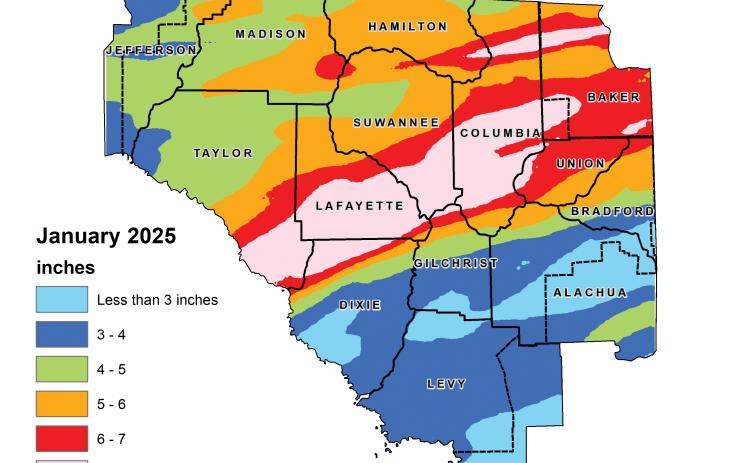
The Suwannee River Water Management District recently released its hydrologic conditions report for January.
The monthly report chronicles rainfall, surface water and groundwater levels, as well as the climate and drought outlook for the area.
According to the latest report, which was released Tuesday afternoon, the SRWMD received an average rainfall of 5.11 inches in January, which is approximately 40% higher than the 1932-2024 average of 3.64 inches. The 12-month period ending on Jan. 31 reflected a districtwide rainfall deficit of 0.75 inches, which is an improvement from the 1.89-inch deficit seen at the end of December.
The report indicated most counties in the district received between three and seven inches of rainfall on average, with parts of Columbia, Hamilton, Lafayette, Suwannee, Baker, Dixie, Taylor and Union counties receiving more than seven inches of rainfall.
Most of the rainfall the district received in January was spread across two days, Jan. 18-19. The districtwide average for those two days was 2.74 inches, which accounted for more than 50% of the monthly rainfall total.
Many river stations finished the month in either the normal (25th to 75th percentile) flow range, though gages on the Ichetucknee, Steinhatchee, Aucilla and Santa Fe rivers trended in the above normal (75th to 100th percentile) flow range due to locally heavy rainfall for the month.
Upper Floridan Aquifer levels across the District reflected normal (25th to 75th percentile), high (75th to 90th percentile), and extremely high (above 90th percentile) levels for the month and ended January with an average around the 72nd percentile.
The National Oceanic and Atmospheric Administration (NOAA) three-month seasonal outlook suggests above normal temperatures along with below normal precipitation throughout the District from February through April.
The U.S. Drought Monitor report released Feb. 6 shows abnormally dry conditions in all or parts of Alachua, Bradford, Dixie, Gilchrist and Levy counties.