
Book recounts Dekle’s pot-smuggling adventures
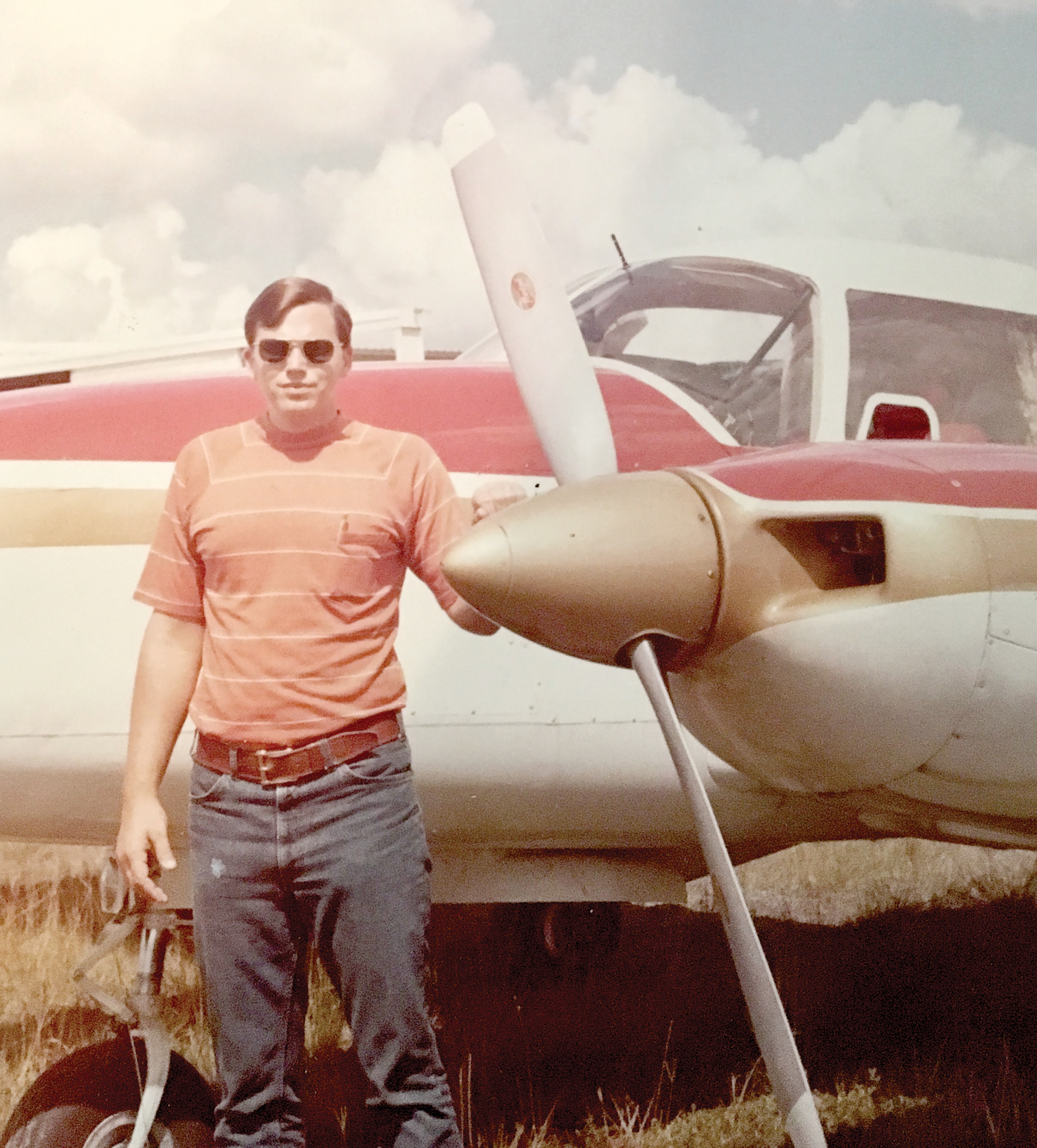
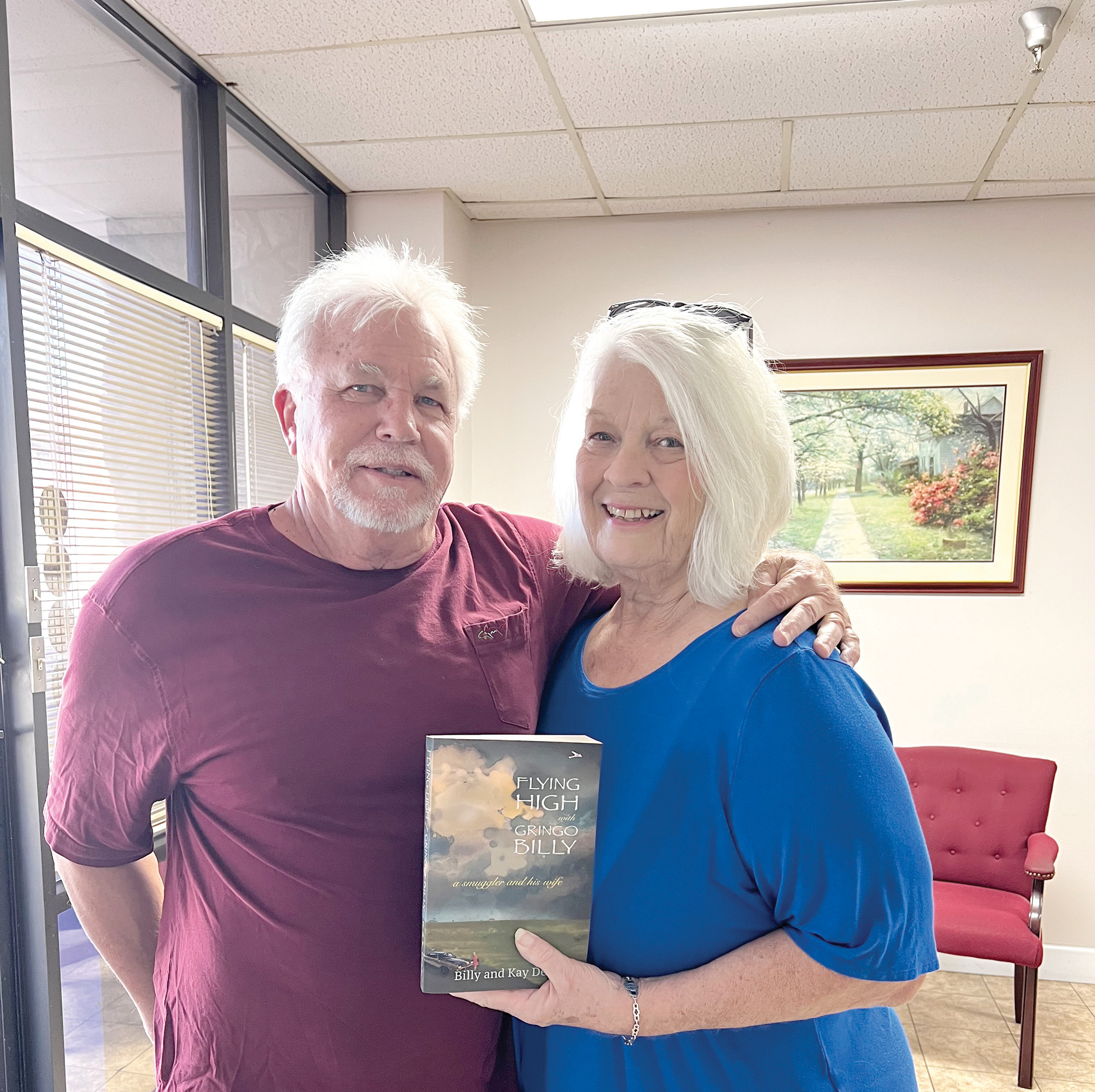
Billy and Kay Dekle’s book, ‘Flying High with Gringo Billy: a smuggler and his wife’ is on sale now through Amazon. (JAMIE WACHTER/Lake City Reporter)
There are no such things as crashes in Billy Dekle’s experience.
Any plane ride he can walk away from is simply a happy landing.
But as the Lake City man took off from Belize in January 1990, headed back to Florida with a plane full of marijuana, the turbine in his single-engine plane blew out just off the coast of Mexico.
Close enough, fortunately, that he was able to get the plane to land, barely, crash landing — or emergency landing, if you will — on the beach in Holbox, an island just north of the Yucatan Peninsula.
“I tore them up, I didn’t really crash,” Dekle said after his wife of 52 years, Kay, mentioned his numerous crashes.
Still, crash or emergency landing, Dekle — a fugitive on the run from federal agents for his role in a drug smuggling conspiracy — was stranded on the beach and had no clue where he was.
After five to six hours of walking, Dekle finally found a little town and eventually found a local, Carlos, who spoke English. His new friend in the fishing village began introducing him to the powers that be in town over drinks at the cantina, including the lighthouse keeper — or the most important man on the island — and the policeman.
As the two new amigos walked to Dekle’s hotel room after a night of drinking, he decided to confess to Carlos about his plane and his predicament: he needed to get to Cancun and back to Florida.
“‘You’re a bandito,’” Dekle recalls Carlos telling him in response.
“Yes, but I’m a good bandito,’” Dekle replied.
Soon enough Dekle was back on his way to America. But his three-year run from law enforcement was coming to a close.
FLYING HIGH
Dekle’s emergency landing in Holbox, eight months before he was arrested in Pensacola and sentenced to life in federal prison, is just one of the adventures from his marijuana smuggling career detailed in “Flying High with Gringo Billy: A smuggler and his wife,” a book published by the Dekles that is now available on Amazon. The 396-page paperback is $25. A book signing is scheduled for Thursday at Phish Tales from 4-7 p.m.
The book, which will be one of three from Dekle’s 12 years of flying loads of drugs from Central and South America into Florida, was never intended to be a book.
Rather, after Dekle received two life sentences following his 1990 capture, he began documenting his trips in letters to his father, who had urged him to write it all down.
“I wasn’t writing a book, I never dreamed of writing a book,” Dekle said. “Basically, it was just for daddy.”
Once Dekle received clemency from President Barack Obama in 2014 and his release in 2016, eventually those prison letters became the answer to numerous inquiries about writing a book.
“Well, I have, kind of,” he said.
There was still more work to be done, though.
First, Kay took the “stream of consciousness” letters that had been typed up by Dekle’s father and saved to a disc, but all in one continuous sentence.
A read through from a teacher friend served as a first edit and then came fine-tuning by Robert Buckland, the Dekles’ publisher in Canada.
‘ONE AND DONE’
While the book details his exploits in the late 1980s, its roots began nearly a decade prior when the Dekles were experiencing financial difficulties or “in debt up over our head” as Kay put it.
Money was being borrowed from one friend or family member to pay back another.
Groceries were being bought by counting out loose change.
But Dekle had the solution.
It would be quick and easy and was all thanks to several federal agents.
While working at the Lake City airport, FBI and customs agents approached Dekle and asked him to wear a wire while offering to fly a load for a local businessman believed to be smuggling.
Dekle declined the offer.
Instead, he alerted the man and about a year later asked him if he could indeed take part.
“I go to the bar and tell him I’m ready, I want to make some money,” Dekle said of his plan to make one trip to make $100,000 and be done.
“That’s what he told me,” Kay said. “One time and we wouldn’t get a divorce. He told me, ‘Bear with me. We’ll do it just one time and then we can start a legitimate business. We’ll be set Kay.’”
That same desire is what prompted Dekle’s run from the authorities in the late 1980s. After getting out of federal — and state — prisons in 1986 on racketeering and drug charges, Dekle found out several of his old partners were subpoenaed by a federal grand jury.
Rather than wait to be arrested again, Dekle fled. First, he went to Belize and laid low for six months, using a new partner for transportation during that time.
Eventually, though, with distribution lagging and his wife wanting to see him, Dekle returned to the U.S., mostly hanging around Pensacola and setting up sporadic visits with Kay and his daughters, Kim and Amy.
“When he went on the run for those three years, his idea was, ‘I can’t turn myself in. If I stay out, I can make money for Kay and the girls,’” Kay Dekle said.
ALL ABOUT THE MONEY
The plan of making big money on that first run before getting out of the game and into legitimate business didn’t work out.
In fact, making big money during his smuggling career never happened.
Oh, Dekle made money. Some of his early flights when he served as just the pilot brought in $40,000-50,000 in cash.
One year — his busiest as he made 23 trips out of the roughly 100 he estimates he made in total — he brought home $1.3 million.
But the money that came in when right back out.
The plane that crashed on the beach in Mexico? Gone and had to be replaced.
There was also the $80,000 plane purchased in California only to be seized by law enforcement before Dekle was ever able to fly it.
“People say it’s easy money, it’s not easy money,” Dekle said. “There ain’t no such thing as easy money. If there is, somebody tell me, that’s what I want to do.
“When you’re making big money, you’re gambling big money. So when it loses, they don’t look at it like you lose big money too.”
Over the years, Kay Dekle said she has often been asked about how much money her husband was making with the whispers around town that the family was filthy rich.
In fact, Kay Dekle said when Dekle was sent away on his life sentence 30 years ago, she figured they had about $100,000 — all from her earnings.
GETTING CAUGHT
After his three years on the run from authorities, Dekle’s days as a free man ended on Sept. 27, 1990, when he was apprehended at a Bennigan’s in Pensacola, a favorite spot for him while back in America.
The capture, though, came as a result of not “being real smart at the time,” Kay Dekle said.
A partner at the time, Wolfman, headed home to Tennessee and was going to try and locate some planes for them to use on future runs.
He asked Dekle for a way to get in touch with him.
Dekle, who said he normally refused to let people have a contact on him, relented. He told Wolfman to call the Bennigan’s and leave a message for Jim.
Once Dekle, who was using the alias Jim Lang, returned to town, he’d call Wolfman back.
Instead, Wolfman got arrested in Tennessee after a fight with his girlfriend. Dekle believes Wolfman let some others know how to reach Dekle and it got to the wrong hands.
“I got soft,” he said. “I said these people are not doing their job to catch me.”
Other times, Dekle was fortunate not to be captured.
On one trip, Dekle had to wait for three days in Nicaragua for the marijuana shipment to be ready. That delay allowed the operation to continue as authorities had the Lake City airport staked out waiting for Dekle to return.
They eventually disbanded, leaving one guy to keep an eye out.
When he saw the plane come in and announced on the radio that he was going to check it out, Dekle’s partners scattered and called off the unloading. Dekle escaped too in a car staged at the airport with the agent in the unmarked car following him up Baya Avenue until turning around near KC’s Produce.
“When he followed me, that’s when they went in and got the load,” Dekle said.
Another time, Dekle was in Belize getting an order ready. When he decided he wanted a better batch of marijuana, he called his partner Freddie Crow and asked him to bring an additional $5,000 for the down payment.
When Crow arrived, he had only brought along $5,000.
The pair had to return to west Florida empty handed and almost into a trap.
Rather than using their normal landing location, Dekle flew to the hangar where they stored the plane. As they headed back to town, they saw police waiting on both sides of the bridge spanning the Escambia River where they were going to trap them with their load of marijuana.
“Luckily Freddie forgot the money. That saved us,” he said.
EGLIN DETOUR
Perhaps Dekle’s most fortunate escape came after a major disaster.
Having problems with the battery on the plane, Dekle decided to not shut off the engine as they loaded. Instead, he urged safety to the crew loading the plane to stay far away from the propeller.
When one person almost walked into the prop, Dekle shut down the work and held another safety meeting.
For added help, Dekle stood near the propeller to provide a line for the workers to go around.
The same worker, though, after unloading one bale instead spun around and headed straight back to the truck through the line of the propeller.
“It shocked me he would even do it,” Dekle recalled. “I yelled at him and he looked at me. If he hadn’t been looking at he me, it would have taken his entire face off. But his expression was, ‘Why are you yelling at me again?’”
When Dekle went to check out the plane after the man was killed, the rest of the crew bailed.
Dekle was left with only 300 pounds of marijuana — normally he’d carry around 900 pounds — and just 75 gallons of gas.
He needed about 95 gallons to get back to their landing spot in the Florida panhandle.
“It was real bad,” Dekle said and that was without knowing how bad the prop was damaged. One of the blades had shattered through a lock ring in the hub of the propeller, leaving it kept in place only by centrifugal force.
“All it was doing was keeping balance and following the leader,” he added.
With no help and no fuel in sight, Dekle decided to head back to Florida, figuring at worst he’d make it to Apalachicola where he could find somewhere to land and abandon the plane.
He also decided to fly as low as he could to avoid burning gas climbing out.
“I flew right at tree top level right over the Yucatan and the jungles and all that,” he said.
When he reached mainland and was gaining speed as the plane kept getting lighter, Dekle decided to keep going past Apalachicola.
Normally, his route included a veer to avoid Tyndall Air Force Base and Eglin Air Force Base.
However, Dekle knew he didn’t have the gas to do that.
“So I flew right over Eglin Air Force Base with a load of pot at tree-top level, or below tree-top level,” he said.
Recounting the story with a former air traffic controller with the military in prison, Dekle said he was advised that he didn’t go without detection. Rather, his escape without having fighter jets accompanying him was pure luck.
ADRENALINE RUSH
While Dekle started running drugs to make money, both he and Kay admit his initial plan to be “one and done” failed for one reason: the excitement.
“It was so much fun,” he said.
Kay added: “It was for money at the beginning but then it was for fun. That’s why we call it, ‘Flying High.’”
Dekle likened the feeling of a successful run — of seeing land on the horizon after crossing the gulf — to that of a driver winning the Indianapolis 500.
Except making the smuggling runs came with one big advantage.
“He’s got to wait a whole ’nother year to do that again, if he can win,” he said. “I can go back right away.
“But that’s not even as good of a feeling as when you think you’re a goner and you find out you’re not. That’s the best feeling in the world.”
GROUNDED CONCERNS
But while Dekle was “flying high” on his numerous trips across the Gulf of Mexico, that same adrenaline wasn’t present at home in Lake City.
In an era before cell phones — as well as concerns about the phone being bugged — Kay often was unaware of her husband’s whereabouts, or his well-being.
After the crash on the Mexican beach, a friend advised her that Dekle was fine, but he had crashed and been lost for a bit.
“I would just be left to wonder,” she said. “He was supposed to meet me, where is he? Is he dead? Did he crash?”
Those feelings, those concerns brought Kay into the book as well at the urging of Buckland, their publisher, who asked that she put in diary entries to counter Dekles’ travels.
“He said he needed that part to make this more personable,” Kay Dekle said. “It brought back a lot of bad, bad memories as well as some good memories.”
LESSONS LEARNED
Looking back, there are too many regrets to mention, from missing his daughters graduating their getting married. He wasn’t around when his grandchildren were born. He was in prison when his parents passed away.
“Probably the memories that he missed,” Kay said.
Dekle added he wishes he had saved money as well as following through on his original “one and done” plan.
“I can’t believe that anyone can live a full life and not have regrets,” he said, adding his biggest was the effect his career had on his family, especially Kay. “But it’s counter productive to mull over your regrets.
“There’s nothing you can do about it. Learn from it and don’t do it again.”